

Advertising is the new tobacco
Barking doesn't work well in a noisy world. But there is hope

I worked in advertising in the FUN YEARS (aka the 1990s). It was driven by creativity and I was so lucky to work with some of the best minds in the business. My husband and I are re-watching Mad Men again and it’s such a delight, despite all the cringe moments of sexism and racism that existed in the 50s and 60s. The 90s were pretty enlightened and I loved working for some of New York’s best agencies as a planner. I learned from people like Pat Fallon, Josh Kilmer-Purcell, Adam Stotsky, Jane Newman, John and Mary Gerzema, Jamie Barrett, and Laurel Cutler. GIANTS in their thinking and their ability to be empathetic with clients.
What a different era we’re in now. Advertising is the new tobacco - few want to be associated with it or even have to tolerate it. There’s zero creativity in today’s advertising, no seduction. Just a lot of noise. Especially online, where most ad dollars are being thrown by the billion, with weak proof of ROI.
Scott Ohsman, Summer Jubelirer and Hayley Brucker interviewed me on their raucous and rebellious podcast Always Off Brand recently where I outline this new reality and how we are creating something completely opposite that puts real people in the driver’s seat instead of barking at them.
The truth is, at LookLook we’re pivoting. We’ll still do custom research for luxury brands, but we’ve also realized there’s an enormous opportunity to turn the existing model of “customer experience” on its head.
The chart below shows how heavily the U.S. advertising industry now relies on paid search. There’s nothing new about this - it’s been done for decades, but brands aren’t doing anything new or creative with it. They can use AI tools that optimize their targeting down to the individual, but they can’t answer the question: “where do I put the message?” CTV (connected TV - ie ads on streaming) is growing, but the most influential consumers pay their way around those ads.
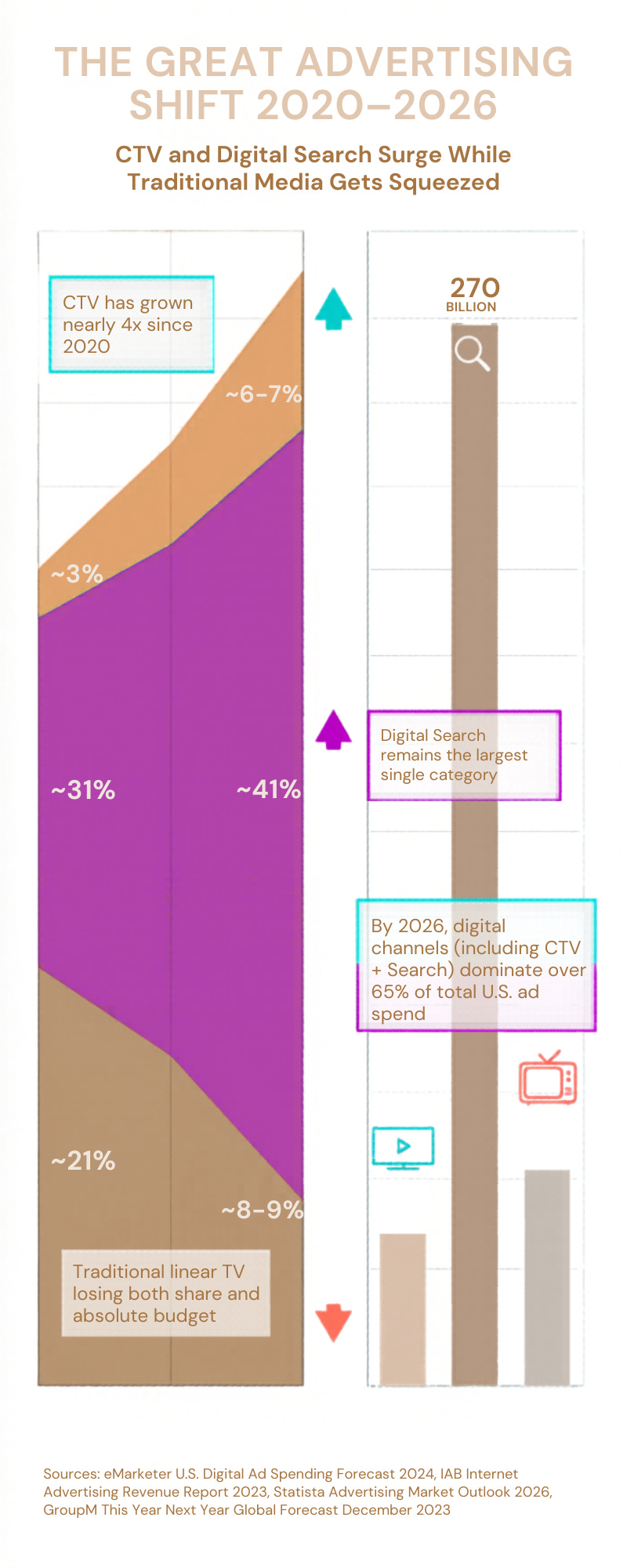
This is especially challenging for luxury brands. People don’t read glossy magazines or newspapers anymore. They pay for Premium YouTube and streaming with no ads. They don’t have cable. They tune out most digital ads and while many social media influencers still have power, the big ones have a lot less than they used to because people are tired of celebrities shilling overtly for things they don’t believe in. So, it’s an increasingly fragmented landscape and hard to pull any lever to make your brand stand out.
What we do know is that connecting companies to real people, the customers they want, can be powerfully seductive if it’s not a blind one-way speech to them. Getting people to focus on a brand’s story in the context of an immersive, several-day study that looks at a larger picture, gives people access to a brand and allows their voice to be heard back to that brand. And it IS heard - we literally hang on their every word. And we present the data unfiltered to our clients.
But here is the magical thing - 1 in 10 people in our studies, on average, go and buy the product after engaging with us. Why? Simply because we have their undivided attention in a way that can’t be captured elsewhere. So, for example, after conducting a study for Lotus automotive, 1 in 5 people went to a dealership in London to look at the cars. Entirely unprompted. 1 in 10 luxury beauty buyers are now avid fans of Victoria Beckham Beauty after weighing in on their line of makeup and fragrance. Our research participants become brand believers. And we’re not even selling to them.
Instead, the brand’s message lives inside the one-on-one dialogue (or curated group chats) that we offer. Yes, clients get insights through our studies, but we’re realizing that the awakening of dormant love for a brand is where the magic lies. And there are network effects, because word of mouth has now surpassed the influence of social media in persuading people to consider a product.
DM me to hear more. We’re excited about further exploring this and seeing how far it can go.
Stay curious, Malinda